08 October 2014

Thoughts on GamerGate

I have a tendency to speak, or in this case, tweet my mind. This is the tweet that ultimately lead to me writing this:


As the title of the post suggests, I'm talking about #GamerGate. Now, I'm not going to go into what GamerGate actually is, for a quick catch up, watch this:


Before I get to the meat of the post, I want to make something perfectly clear: I personally believe that Zoe Quinn, and the accusations against her have very little to do with the issue at hand. If she and sex with a Kotaku editor would that have caused a conflict of interest when they covered her game? Yes, certainly. Should they have disclosed it if it was true, or not written about the game at all? Also yes. However, beyond that, her life and supposed sexual habits are entirely irrelevant.

The articles mentioned in the video that were released by a bunch of websites (all at once interestingly enough) decried "gamer culture" by picking out the worst, stereotypical elements of the culture and slamming them. Everyone knows the stereotype of the antisocial, misogynistic, teenage basement dweller, gorging himself on doritos rarely seeing the light of day, or for that matter a shower. Do these people represent gaming as a whole? No, that'd be like saying all Americans are gun toting idiots who want to rule the world (please, lets not go further than that on the matter). So why were these articles published? From a glance, they're a response to the hate aimed at Quinn for being involved in the supposed conflict of interest. Misogyny in games, and the gaming community has been a hot topic for quite some time now, largely sparked by Anita Sarkeesian's "Feminist Frequency" videos. What I believe the "Gamers are Dead" articles are, is an overreaction to the vocal minority throwing hate and death threats at the likes of Quinn and Sarkeesian. The behaviour displayed by certain elements of the gaming community is disgusting and shouldn't be tolerated. However, reacting to these few, very vocal people with a slew of articles decrying gaming culture as a whole is a complete overreaction.

Many gamers are understandably rather upset by these websites slamming their entire culture. A lot of these gamers went on to make very reasonable complaints, and began boycotting these publications. But as usual, we have the trolls. The misogynistic, angry, noisy trolls. Did the media do the sensible thing and ignore the trolls, instead paying attention to the sensible discussion GamerGate could, and should have fostered? Of course not, the trolls are being used as an example of what gamers are like. That's assuming the media talks about it at all, which interestingly enough, they haven't been, which brings me to the video that got me interested in discussing GamerGate in the first place:


Due to the general silence on the matter of GamerGate, when I saw TotalBiscuit had been involved in a discussion regarding it, I decided I'd give it a listen. I respect TotalBiscuit and figured he'd have a good opinion, which yeah, I believe he did. It's a pretty long video, but the most important point I took from it, is how messed up it is that many websites are flat out refusing to cover the issue, or allow any discourse regarding it. Many subreddits on reddit have banned any discussion of it, 4chan have, in an extremely bizarre move, banned any discussion of it. This has lead to much of the discussion taking place on Twitter, which really, due to it's format of short posts, isn't the best place for an in depth discussion. This has lead to rather a lot of people voicing their opinion, but not necessarily discussing the issue itself.

So on one side, we have a slew of disparaging articles full of poor stereotypes, and then total silence. On the other side we have a group of very justifiably angry gamers, What I believe has happened (and this is obviously my personal opinion) is that game journalists saw an issue within gaming culture, a very real issue, and proceeded to blow it way out of proportion. In response, a lot of gamers have decried these articles, and done one of the few things they can in response: boycott, and inform advertisers of said boycott. I don't think there's anything wrong with that response at all, it's one of the few things that can actually be done. However, we still have the issue of the vocal minority the articles were decrying in the first place, which brings me to the reason I'm writing this. We need a reasonable discussion. Most people want a reasonable discussion (on the GamerGate side at least). The only way we are possibly going to get a reasonable discussion at this point is if reasonable comments and tweets drown out the unreasonable ones. Hopefully game journalists will start to notice, and rather than hiding under their respective rocks, actually come out and engage.

This brings up the question of what needs to be discussed, it's also a question that I honestly really didn't know the answer to. As I said, I'm quite new to the whole issue. Luckily, my tweet, while receiving a few not so helpful responses, did catch the attention of a person I'll refer to as Soul of a Gamer, or just Soul, 'cause I'm way too lazy to type the whole thing out every time. Soul is one of the many gamers wanting a good discussion regarding the whole issue, and we had a fairly lengthy one regarding topics that need to be talked about, and what the members of the GamerGate movement actually want.

So what do we want to discuss? I've rambled a lot, so I'm gonna do fairly short bullet points. After all, this post is meant to foster positive discussion.

  • Gamers are a very diverse group of people. Is it really helpful to lump them into one homogeneous group that is horribly misogynistic and sexist?
  • Diversity in games. We don't necessarily need to change the games we have, but we need to encourage the creation of games covering a diverse range of people and subjects. How do we do this?
  • How do we get a more diverse group of people working in the game industry?
  • How do we get media to pay attention to the reasonable side of the discussion, and ignore the vocal trolls?
Gamers aren't one person. Gamers aren't, as a group, horrible, racist misogynists. We don't want to be lumped into that category. The horrible, racists misogynists, believe it or not, aren't hugely welcome in the gamer community. We can never silence the trolls. That's just how the internet is. What we can do is try to bring attention to the sensible discussion that is taking place. Will it be hard to do? Of course, the trolls are so much more entertaining to talk about. But we can't give up. Gamer culture isn't going away any time soon, and what we do will affect it's evolution. So if you care, speak up. Encourage women to start making games too. Hell, Rhianna Pratchett has written some amazing games, look her up. We need more of this, diversity is always a good thing, and honestly, most gamers want it.

Most importantly, I think we need to foster a good perception of gamers as a culture. Gamers are people who are extremely into games, Soul put it very well "You aren't a gamer for playing games, just like you aren't a football fan for watching a game of football. You are a gamer when you say you love gaming as a part of your life. Much like being a football fan, if you stop being passionate, you stop being one." Gamers are a passionate group, we love games, our passion is largely responsible for this controversy. Gamers are angry at being stereotyped as some awful group. It needs to stop, and open discussion is the way to do this. Gaming culture is huge. There are so many gamers, from all sorts of different backgrounds, we need to remember this.

Oh, and as a foot note, think before you speak.

Passion

I've always wanted to find what I'm passionate about. For some people it seems so incredibly straight forward. They get wound up about sports, or music, or teaching young children, or human rights. I don't think that my problem is that I don't care about anything, so much as I find it hard to focus on one issue more than any of the others. One minute I'll be fired up and ranting about the healthcare system and its failings, the next I'll be enthusing about an interesting critique of a video game. It's probably a very stupid thing to be bothered by, but I do wish there was something specific I could focus on, become extremely knowledgeable about, and do something in that field. Perhaps it's just a part of being young.

I have recently however, managed to narrow certain interests down to the point where I feel I'd quite like to get into politics. I spend so much time complaining about the state of the country I live in (which, compared to others really isn't bad at all) that I may as well see if I can do something about it. But even then, I'm still confronted with the question of what issue I would focus on once I get into a position of power. Would it be education? Healthcare? Equality for women? I'm not an expert on any of these things by any means, so what right would I have to speak on them? I think these questions are very telling as to what the real problem I'm having is. I don't feel I'm particularly good at anything. I know I like to think I'm right all the time (a lot of people who know me will agree I have this attitude), but honestly, I'm often not that confident. I do honestly believe I know about a lot of topics, but I often feel like I don't know that much about any of them. Not any deep knowledge any way. This post has turned disturbingly honest, I suppose I should be thankful my grandmother is the main person who ever really reads it (sorry for not posting more Oma, I promise I'll try write more often).

I think I'm probably just scared. I'm nearly two thirds through my degree, and it's just about time that I actually start real life and live as an adult. Start a career, save up for future life, plan on having a family. The problem is, I don't really know how I'm going to do any of this. As a child you think adults know everything, but then you reach this supposed adulthood, and you know no more than you did before. It's so gradual that it feels like no progress is being made at all. Intellectually I know I know more than I did at 15, but often I really don't feel like I do.

02 July 2014

Neglect

I've neglected this blog pretty badly. It's not like I've forgotten it exists, I just haven't been able to come up with anything remotely decent to write on it, which is dumb, because quite a bit has happened the past few months. I am planning on starting writing properly for the first time in years, so I should have some interesting things to put up after a while. The story I'm wanting to work on is going to take a fair bit of research though, so it's going to be a while before anything is actually written. However, said research might lead to some interesting subject matter for blog posts, so we shall see. I'm going to specifically be looking into schizophrenia, borderline personality disorder, and bipolar disorder. It's handy having a nursing student for a fiancée who can give me lots of info. As the nature of the research suggests the story is going to be about a man with some pretty serious mental health issues. This honestly makes me a little bit nervous for a few reasons, mostly because I really don't want to misrepresent the effects of these issues on a person. I (at least I'm pretty sure) don't suffer from any of those issues, so I can only rely on research as opposed to personal experience.

On another note, despite my shaky confidence in how well I did this past semester at uni, I'm really looking forward to the upcoming one. I discovered I was a bit behind on electives, so it's going to be a pretty diverse half year. I'm taking Philosophy of Religion, International Conflict, Culture in Medieval Europe, and Postcolonial Literature. I can't quite remember off the top of my head what books I'll be reading for the last one, but I do remember that they looked really, really interesting. Best part of doing an English degree has been the books I've read that I never would have considered reading otherwise.

19 March 2014

Vignettes

Last night, or early morning more like, I came to the (most certainly correct) conclusion that I really need to write more. This is not a hugely unusual conclusion for me to come to. What made this small event stand out from the other, extremely similar moments, is that I actually wrote something. It didn't take me long to decide to turn it into a project.

I googled writing prompts. I figured my main problem at the moment was not knowing what to write, so I decided that I'd get a website to tell me. It worked. I came up with a fairly simple, but in my opinion, not too bad for something made in 10 minutes with minimal editing, vignette.

What If

He always hated speaking in public. The inquiring eyes gazing as if they could see into his very soul. As he approached the podium, his notes gripped with sweaty hands, all the possible problems that could arise ran themselves through his almost panicking mind. What if he stumbled over his words? What if there was a technical failure and no one could hear him? What if his voice abandoned him and he was left standing like a fool? Worst of all, what if he failed to truly represent the topic on which he was speaking? The topic so important to him he had spent half a life-time studying. What if he couldn't make them understand, to see why it was so necessary to pay attention? What if his words failed to make an impact on even one person, resulting in his life's work coming to naught? These anxious thoughts, flashing through his mind in the short ten seconds from the side of the stage to the podium very nearly paralysed him. His fears, very nearly self-perpetuating, continued to clamour ever louder in his brain as he finally set his notes upon the dark, wooden surface of the podium. He stood and looked into the audience, barely able to see them through the glaring lights pointing towards the stage.


“In 1948...” his words began to flow.


The writing prompt I used for that was from: http://www.dailywritingtips.com/writing-prompts-101/

Being fairly happy with the result of my short project, I decided I would make this a habit. For at least a week (could very well turn out to be longer) I will write a vignette based off a writing prompt. They'll be loosely connected, in that they're all the same character, but they won't be going into any great detail (being rather short), and due to the nature of what writing prompts, may vary greatly in subject matter. It's going to be interesting to see what I end up with by the end of Sunday. Here's the second one:

No!

He couldn't believe what had just happened. He knew all the rules and good practices regarding backing up your work, but the one time he slipped up was the most vital. Hell, he'd barely had any time to back up the damn file in the first place! Hours of work gone in an instant. He swore to himself from that moment on he would at the very least handwrite the rough draft of a project, if not the entire thing. He would have to spend time double handling everything, typing it up on his computer after spending what were sure to be agonizing hours writing his work by hand, but surely that was an improvement over the potential alternative.

Writing prompt from: http://www.creativewritingprompts.com/ #164


I'm also going to be posting them over at my literature/books/writing focused tumblr (sort of a blog but kinda different): grumpylit.tumblr.com

I'll be posting other stuff there too, hopefully it ends up interesting.

18 March 2014

Vegas

It has been months since I've written here. There are two reasons for this:
1. I haven't had anything particularly interesting happen since I got back from the U.S.
2. I've felt that I should continue the U.S. series of posts rather than put something else in the middle of them, and for some reason I've felt reluctant to write the Vegas post. I have no idea why.
Vegas was amazing. Very, very tiring, but amazing. I think the main issue I have with writing about it is that it's so hard to effectively put into words. Because of this, I'm going to settle for doing a highlight reel type thing.

Now, the absolute number one best thing about Vegas had very little to do with Vegas itself. My best friend Ben managed to come down from New York, and it was absolutely amazing to see him again. It had been years, and hanging out with him was the best three days I've had in a very long time.

We spent a large majority of our time either wandering around the city, or eating. My gosh, the food was amazing.


Sadly this photo was taken before the fire starting to appear increased ten-fold and Ben and I freaked out, but hey look, giant metal praying mantis!

The other highlight of the Vegas trip did not actually occur in Vegas. Didn't even occur in Nevada for that matter.

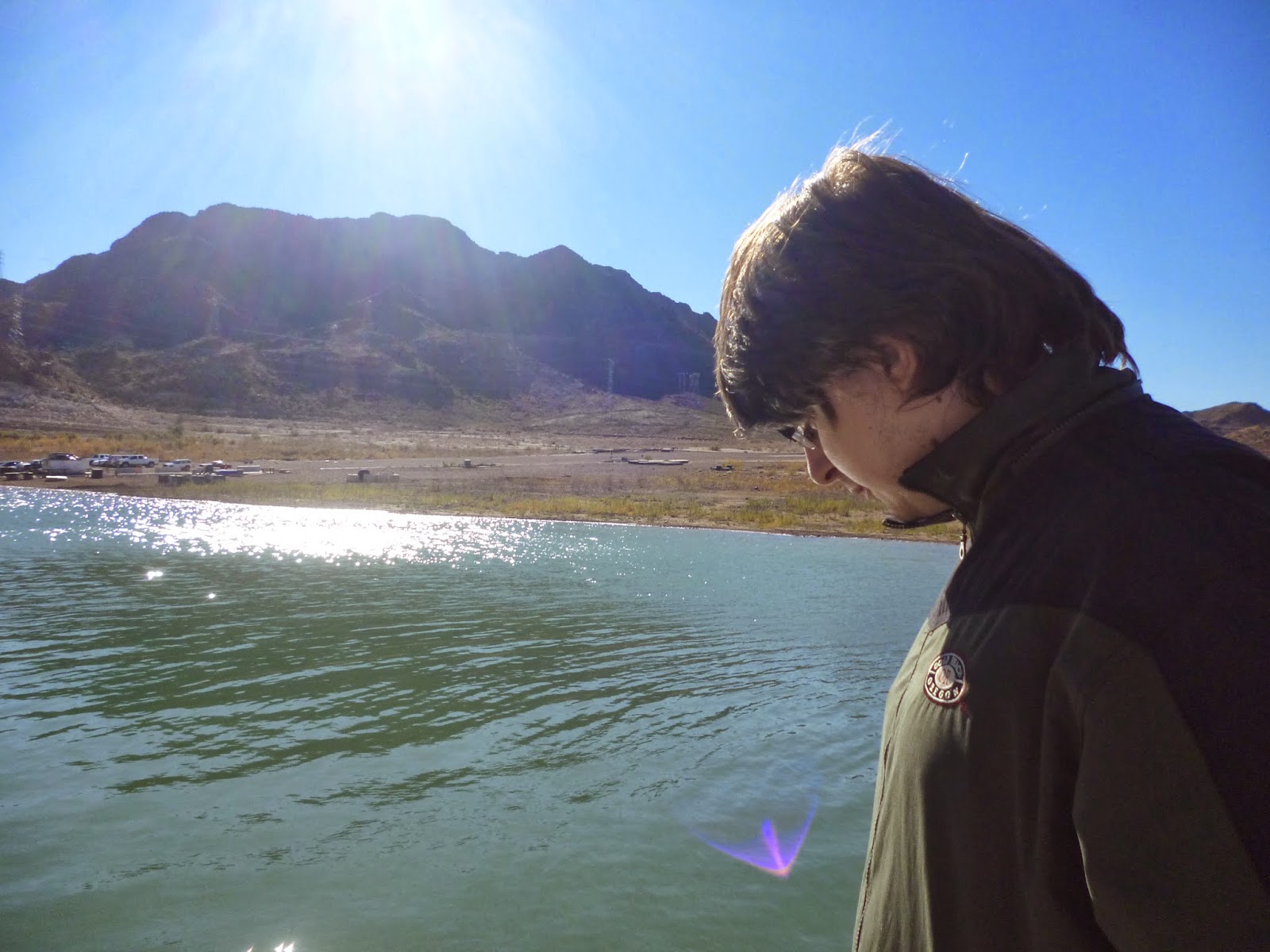
Being so close, Laura and I felt we had to visit the Hoover Dam, and man it was amazing, as was the trip there. I feel like a lot of people fail to realise how absolutely beautiful desert can be, and then to see such a massive body of water in the middle of said desert. It's one of the few landscapes that I hadn't really seen in my life before, so it was a pretty epic part of the trip.


The final highlight was seeing the show Absinthe. It was basically a small show in circus format, mostly focusing on incredibly impressive acrobatic acts. It was in a very small venue, probably 150 people at most, and was absolutely mind blowing. I've never seen anything quite like it. I won't be posting any photos however, largely due to the fact I'm not sure it'd actually be legal to do so.

Anyway, this finally brings my series of posts regarding my U.S. trip to an end. I'll probably start posting literature and history related stuff. Regardless of what I do post, I really need to get back into the habit of it, it has been far too long.

27 December 2013

United States Continued (Rather late): Oregon

I'm rather late continuing on talking about my US trip, but nearer to the end of it I simply did not have time to blog (you know, Vegas), and shortly after arriving back to NZ Laura and I found out that we were moving. We're just about all done moving now, thankfully.

After a few weeks in Garberville, it was time to go off to Oregon. Laura's uncle, Dan, and her cousin, Alex, came over from Hawaii for the trip. The purpose was an early thanksgiving dinner with extended family of Laura's.

Not wanting to be crammed three across in the back of Laura's Dad's truck, I opted to take a ride up with Laura's uncle. This, it turned out, was a rather good decision. Not only did I manage to have considerably more space than I would have otherwise, but the stops we ended up making on the way were well worth it. I'm afraid I don't have any photos of the trip at this point (will try put them up when I manage to get a hold of them), so descriptions will have to suffice.

First stop was another visit to the Founder's Grove (the redwood forest I had been to earlier). While I was certainly happy to go back for another visit, we didn't end up lasting too long as it was rather cold. It was finally starting to feel like winter there, and being out of the sunlight just got too much. I also (not surprisingly) was unable to make my way back to the albino redwood tree to show Dan and Alex, so there wasn't all that much keeping us there. Still, it was great to go back for another quick look. There really isn't anything quite like it in New Zealand, despite the fact we do indeed have some pretty massive trees.

Second stop occurred when we decided we were all rather hungry. Alex starting searching for good places to eat in Arcata on his phone, and a small taco truck outside a petrol station was settled on. I was a little skeptical, I must admit, even though I've eaten plenty of street food in Thailand, but I was up for pretty much anything at that point and decided to go for it, hoping I wouldn't end up needing to make multiple bathroom stops the rest of the way. Turns out, it was a great decision. The truck was obviously popular, there were a good 8 people at least outside it when we showed up, and another 15 or so would have come and gone in the time it took us to eat. A particularly enjoyable specialty they had was Korean BBQ meat on their food. A little odd for a Mexican place, but it ended up working extremely well. I must say, it's some of the best Mexican (and Mexican fusion) food I've ever had.

The third stop was very soon after the second. Alex and Dan had been to a micro brewery a couple of days previously, and one of the bar tenders there and recommended to them, Redwood Curtain Brewing. We opted to give it a visit, as it was on the way. This turned out to be another great decision. Dan bought us a taster pack each. 11 beers, and cups that held a surprising amount of each. If I'm entirely honest, I have to say that I wasn't a huge fan of the majority of them. However, the four or so I did enjoy made the trip more than worth it. In New Zealand American beer gets a lot of flak, and in all fairness, the mass produced beer is pretty terrible. But the micro breweries really do produce some amazing beer.

After that stop we realised it was getting rather late and decided that was it for the day. Well, other than a quick stop at a beach, but 5 minutes doesn't really count. While the rest of the trip was fairly uneventful, the view made it rather enjoyable. The coast line of Northern California/Southern Oregon is some of the prettiest I've seen, and that's saying a lot coming from a Kiwi.

23 November 2013

United States of America pt. 2

Off to Oregon tomorrow, so I thought I'd write another blog post regarding to my time in Northern California. After we return from Oregon, we'll be in Garberville for one more day. After that we're off to San Francisco for a couple of days, and after that, Las Vegas. It's been a fairly relaxed past couple of weeks, and with how busy we're likely to be over the next couple, it's probably a good thing.

First off, as promised, one more photo of the apple trees:


Probably the most interesting day so far was last Saturday. Laura's friend Arturo picked us up in town, and took us to a redwood forest, and then on to a near by (kind of) city, Eureka.

I'm definitely not much of an outdoors person, but the redwood forest was nothing short of amazing. It felt very different to the bush I'm used to in West Auckland. While it was not very dense at all, the trees themselves were ridiculously tall. Some of the tallest in the world. Somehow the lack of density made the height of each individual tree more impressive.


After that, we went to pretty much the complete opposite of a redwood forest. Target. It's kinda like the Warehouse, but bigger. And cheaper. Soooooo much cheaper.


I did get some new clothes though, and clothes I actually needed as opposed to more black tshirts. Laura grabbed plenty of makeup that would cost a ridiculous amount in NZ, and I stocked up on snacks. We also went to Walmart, because it was apparently something I had to experience. It was depressing. Let's not talk about Walmart.

When at home rather than out and about, I've been helping more around the house a bit, and reading. A lot. Just about finished A Clash of Kings, and am thinking about moving on to Farenheit 45.

Will give an update about being in Oregon when I get the chance. :)

15 November 2013

United States of America

And I'm back to blogging. Haven't posted at all in a few months, my second semester of university was really quite busy, and there was a slew of other things going on at the same time that lead to me just not having time for much writing that wasn't uni related. Anyway, I'm back to it.

On the 11th of November, Laura and I boarded a plane to go to the U.S. It's the first time I've ever been here, and has been pretty cool so far, even though we've mostly just been at Laura's house. The trip there was, for the most part, uneventful, although we managed to almost miss one of our flights. Lack of a boarding call can lead to issues it would seem. We ate Mexican food the night we got here and it was amazing. People weren't kidding when they told me about how huge the portions are here.

The past couple of days we've been working on making apple and pear juice. This included picking the apples, and grinding them up into a pulp before extracting the actual juice.


I'll see if I can get some more photos later on.

Today we also went to the nearby town, Garberville. It was very much a small town, with (as expected) rather a lot of hippies. Also got to try my very first burger in America, and I gotta say, it was pretty delicious. Surprisingly enough, I've actually LOST weight since I got here. I suspect that has something to do with the fact that I'm moving around a lot more as opposed to diet however.

What I've found to be the strangest here has honestly been the driving. I've only ever been in countries in which they drive on the left, and even though I've just been a passenger, driving on the right side of the road feels really, really weird.

I've also found the television to be fairly odd, most specifically the adverts. The main two that have stood out are adverts for prescription drugs, and an advert for a class-action lawsuit. Just not things you'd see in little old New Zealand.

The next few days I think will be more of the same. Hopefully going up to Eureka and Arcata with a friend of Laura's on Saturday, which should be fun. Going to tour a brewery and eat good food. 


23 August 2013

I Just Don't Get It

I've been following Anita Sarkeesian for around a year now, since she started her Kickstarter campaign. In short, she's working on a series of videos discussing sexism in video games. While there are definitely things I disagree with her about, and I feel sometimes she does make things seem worse than they actually are, discussing sexism in video games is important. Currently it's still a pretty male dominated form of entertainment, and while it may be ok to, at times, show depictions of women that are not considered entirely appropriate, the trend of doing so in video games is somewhat concerning. This is essentially what Anita's series "Tropes vs. Women in Video Games" talks about.

Today she posted this video on Facebook:


I have known that she has been harassed for her series since the start, and while the harassment was predictable, it is disgusting. I did not however, realize it carried on to the extent she talks about in her video.

My opinion of how fucked up people have been behaving aside, I just don't get why. Why are these men seeing her as a threat? Do they somehow think she's going to take their precious video games away from them? Or to take it even further, what would be so bad about having at least a few games that actually have strong, respectfully portrayed women? Sure, games are used to fuel male fantasies a lot of the time, but I'm sure games that facilitate fantasies of male strength and power will continue to be released as long as they make money, which will be for a very, very long time. So why do so many people feel threatened by Anita's video series? Or do they not feel threatened and are just using the behaviour shown in the video as a means to show off? Maybe it's both.

Ultimately, the reaction to what Anita is doing is really just proof that more people need to be criticizing our media. As has been shown, people are going to react badly at first, but maybe if enough people get loud enough, things will start to change.

22 August 2013

What Makes a Classic

For the first time, I am going to post an essay that I wrote for one of my university classes. I had to discuss what makes a book a classic, and who (if anyone) gets to decide.

Classics: Who gets to decide?
by
Andre Landwer-Johan

When studying, or even discussing literature, one will often come across the term “classic”. It is a term used as a descriptor of a piece of writing, normally that piece of writing being a novel. When referring to a book as a classic, the speaker is regularly using it as a way to classify the work being spoken of as somehow superior to non-classics. What is it that makes a piece of work classic? Is there a set criteria of what makes a novel a classic, or is the question a purely subjective one? I believe that there is an objective means of measuring whether or not a book is a classic, but it may not be what you would first expect. For a book to become a classic, it must stand the test of time.

If one is to stick to using terms traditionally, “a classic is a work written in ancient Greek or Latin” (Lidden) and widely studied in scholarly institutions. Looking at slightly more recent times, books considered to be classic were used in schools as a method of teaching “Standard English”. (Guillory, pp. 235) When education began to become common place in the English middle class, a method of learning more refined, and standardised speech was considered a necessity. Thus, “works of English literature were collected into anthologies comprising a selection of the best in each genre; and these anthologies which looked very much like the Norton or Oxford anthologies of our day, were employed in the schools as a means of teaching and disseminating Standard English” (235). Essentially, the definition of “classic” began as a more objective concept as opposed to a subjective one. Books were selected for their perceived merits by a group of scholars, focusing on quality of writing and adherence to “Standard English”. By selecting specific books to be considered worthy of being taught in the classroom, scholars helped promote proper usage of grammar in speech and writing, through the medium of stories. This lead to the creation of a “canon” of books, and books in that canon were considered to be classic.

What makes a book a classic now? High quality writing, while desirable, is hardly an indicator of an enjoyable story. What reason is there to read a fictional novel if the story is dull? For a book to be widely considered as classic, not only does the writing have to be of high quality, but it must have a story capable of engaging a wide audience. I believe that a strong, engaging story is in fact more important than “correct” or “proper” writing. Take, for example, the beginning lines of The Catcher in the Rye by J.D. Salinger, a book widely regarded as a classic: “If you really want to hear about it, the first thing you'll probably want to know is where I was born, an what my lousy childhood was like, and how my parents were occupied and all before they had me, and all that David Copperfield kind of crap, but I don't feel like going into it, if you want to know the truth.” (Salinger, 1) Salinger's style of writing can hardly be considered grammatically correct, yet The Catcher in the Rye is often referred to as a classic, and is even taught in some schools. However, due to the lack of grammatical correctness within the book, it would have been prevented from entering the classical canon used in schools in an older time. This leads one to conclude that books no longer need be in the canon of higher literature to be considered classic.

Despite many considering The Catcher in the Rye to be classic, there are also a great deal of people who, not only do not feel the book is a classic, but actually actively dislike the work. This is due to the fact that the fictional novel is a piece of art, and art is subjective. Yes, one can speak of art in objective terms, but these terms only serve to state basic facts, such as “the book is in English” or “the book was written in 1951”. In recent vernacular the word “classic” has started to be used more as a way of describing ones opinion of a piece of art as opposed to being used to objectively say a work is in the canon of books widely taught by educational institutions. Recently, even some graphic novels have been referred to as classic (Lidden), and one can certainly not say Watchmen is widely taught in schools. If someone does not like a certain book, whether or not it is widely regarded by the public as a classic, they are not likely to describe the book as such, and even if they do, it may be used in a slightly derogatory way.

This brings us to the question, what makes a book a classic, and who gets to decide? I feel Charles Augustin Sainte-Beuve put it rather well: “A true classic, as I should like to hear it defined, is an author who has enriched the human mind, increased its treasure, and caused it to advance a step.” (Sainte-Beuve) By this definition, for a book to be classic it must be worth something, in that it furthers the development of the minds of its readers. Once again, whether or not one feels a book has helped them grow in some way is a largely subjective matter. The most objective means of measuring whether or not a book is to be considered classic is simply time (although the amount of time required is once again, debatable). If a book can stand the test of time, and still be widely read long after publication, it can be considered a classic. I feel this is an accurate way to judge whether or not a book is indeed classic, as a book that is of poor quality, or simply irrelevant will fade away. For every Great Expectations there is bound to have been countless books written that we no longer remember.

In conclusion, it is simply time that makes a book a classic. No one person, or small group of people decide a book is a classic, it is a decision made by society as a whole. If a book can stand the test of time, and be widely read in a world it was not written in, that book is a classic.

References:

Lidden, Daniel. “What Are Classic Novels?” Wisegeek. Web. 29 July 2013.

Guillory, John. “Canon.” In Frank Lentricchia and Thomas McLaughlin (eds.). Critical Terms
for Literary Study. Chicago and London: University of Chicago Press, 1995. 233‐249.

Salinger, J.D. The Catcher in the Rye. New York. Bantam. 1951. Print.

Sainte-Beuve, Charles Augustin. “What is a Classic?” Literary and Philosophical Essays. Vol. 32. 1909-14. Bartleby.com Print. 29 July 2013.